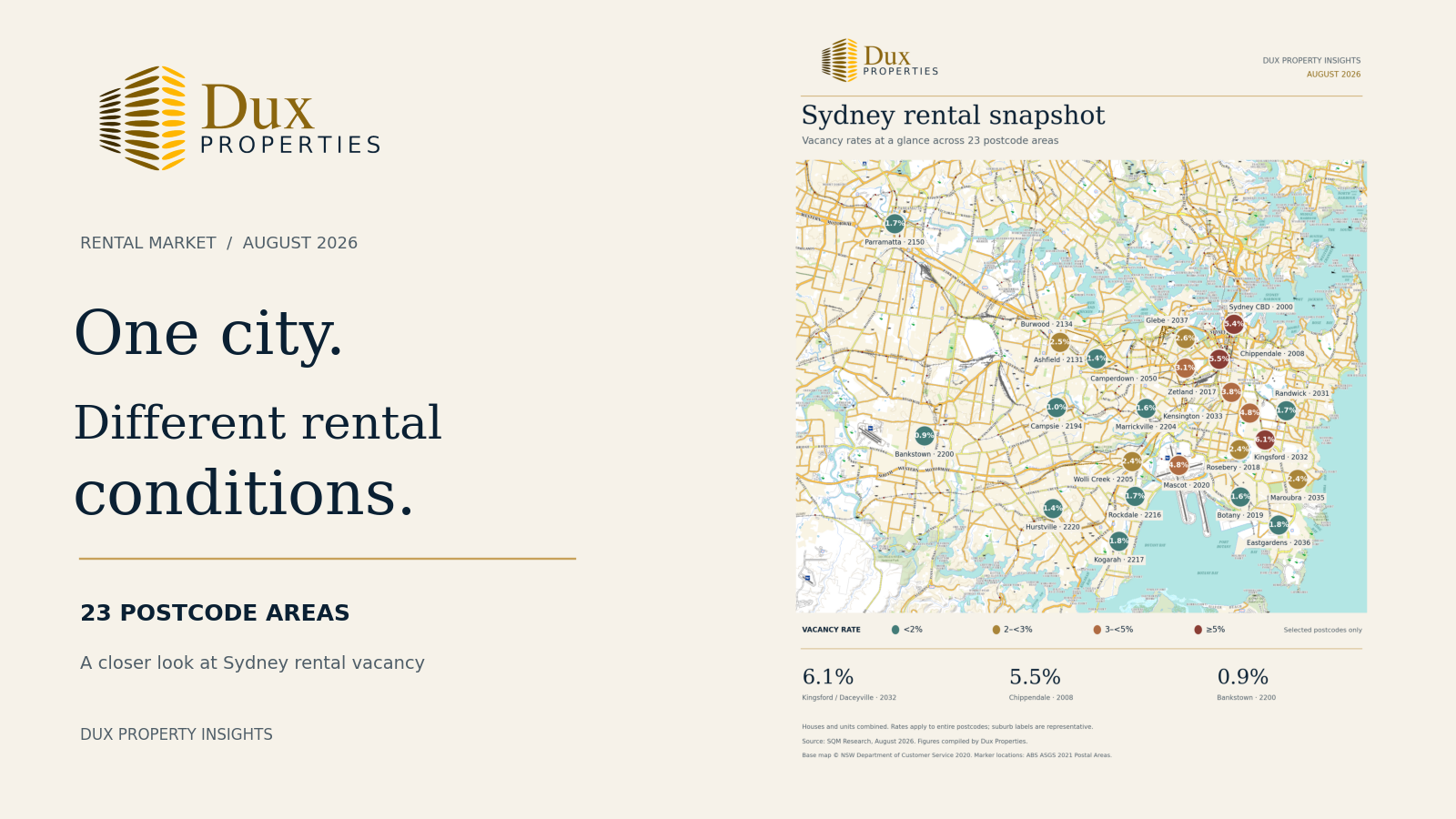
Rental conditions vary across Sydney. Dux Properties has mapped August 2026 vacancy rates for 23 selected postcodes to give owners a clearer view of the areas they follow.
Rates in this selection range from 0.9% to 6.1%, covering the CBD, areas around the University of Sydney, the eastern suburbs, the Inner West and selected southern and western locations. This is a snapshot of selected postcodes, rather than comprehensive coverage of Greater Sydney.
Where are the differences?
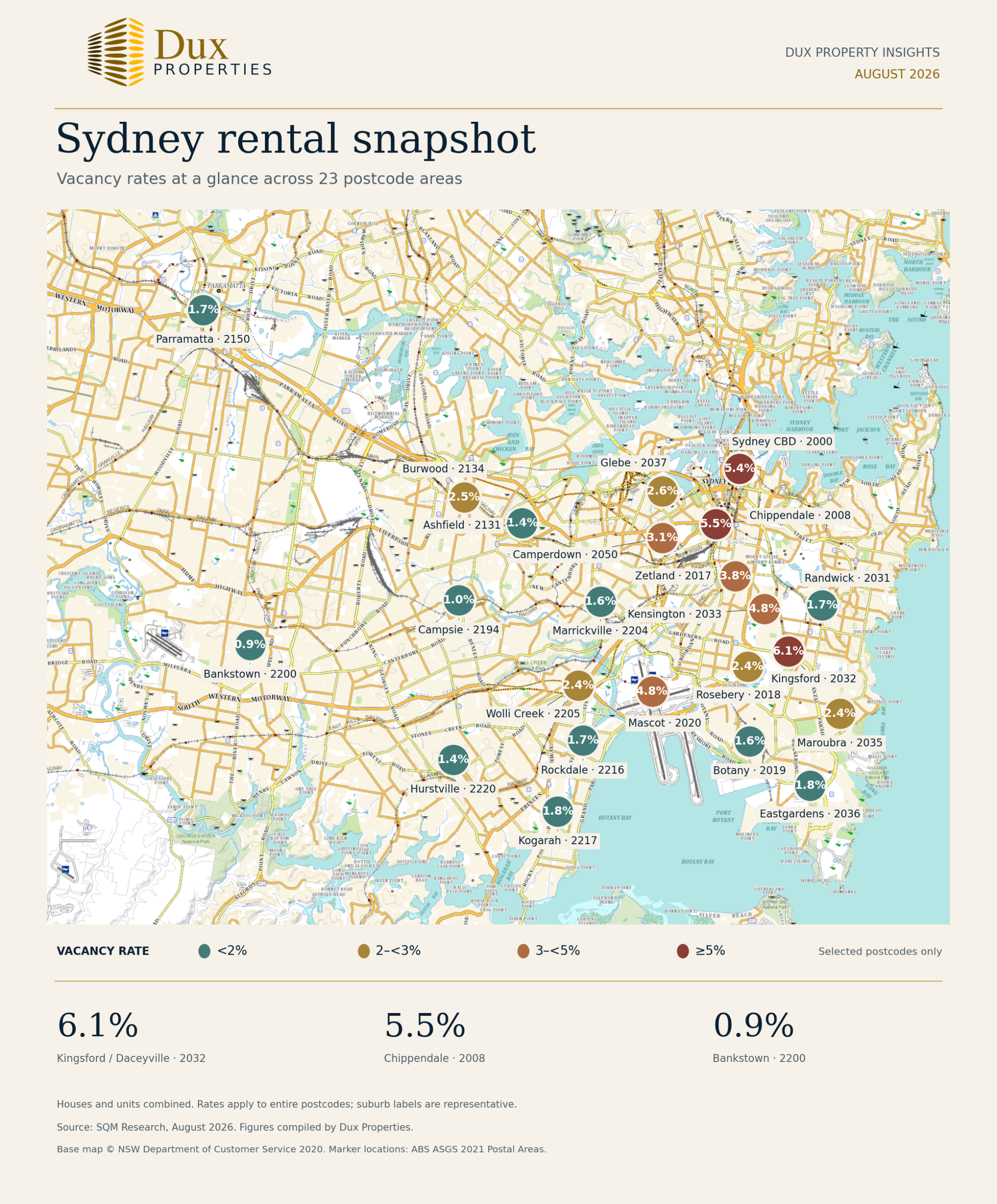
Within this selection, postcode 2032 (Kingsford / Daceyville) recorded 6.1%, followed by 2008 (Chippendale) at 5.5% and 2000 (Sydney CBD) at 5.4%. Postcodes 2033 (Kensington) and 2020 (Mascot) were both at 4.8%.
At the lower end, 2200 (Bankstown) was at 0.9%, 2194 (Campsie) at 1.0%, and both 2131 (Ashfield) and 2220 (Hurstville) at 1.4%. The spread reinforces the value of examining local conditions when planning a leasing campaign.
University precincts need separate assessments
Vacancy rates for 2008 (Chippendale), 2050 (Camperdown) and 2037 (Glebe) were 5.5%, 3.1% and 2.6% respectively. Properties around the same university should still be assessed against the competition in their own locations.
The eastern suburbs also show a contrast: 2032 was at 6.1%, compared with 1.7% in 2031 (Randwick), a difference of 4.4 percentage points. A single monthly snapshot identifies that gap but does not establish its cause.
Applying postcode data to an individual property
The figures cover entire postcodes and combine houses and units. Suburb names on the map are representative labels. Competition can still vary within a postcode by dwelling type, bedroom count and whether a property is furnished.
A 6.1% rate for 2032 therefore does not directly describe the market for a five-bedroom house in Kingsford. The map also contains no month-on-month comparison, so it cannot show whether conditions in a postcode are improving or deteriorating.
Where vacancy is higher, check whether competing listings are concentrated in properties similar to yours. Where vacancy is lower, condition and rent positioning still matter. Actual enquiry and application quality should continue to inform the initial assessment.
Related reading: Sydney rental market update for August
Owner Takeaway
Before listing, compare competing properties with a similar location, dwelling type and features, then use recent leasing results to help set the asking rent. Review enquiries, inspection attendance and application quality early in the campaign. If response is weak, assess pricing, photography, inspection access and property condition. Consider achievable rent alongside the likely vacancy period.